 DrumScript
Digital Signal Processing (DSP)
DrumScript relies on three major pillars of Music Information Retrieval (MIR): Source Separation, Onset Detection, and Tempo Estimation.
1. Source Separation (Demucs)
Before transcription begins, we often need to isolate the drums from the rest of the band (guitars, vocals, etc.).
We utilise the Demucs model, a state-of-the-art Hybrid Transformer architecture. Unlike older spectral masking techniques, Demucs operates in the waveform domain to cleanly separate instruments with minimal “bleeding.”
Paper: Hybrid Transformers for Music Source Separation (Défossez et al.)
Implementation: See
drumscript.audio_processor.stem_splitter.
2. Onset Detection
To transcribe a drum, we first need to know when it was hit. This is called Onset Detection.
We analyze the Spectral Flux—essentially measuring how quickly the energy in the audio signal changes. A sudden spike in high-frequency energy usually indicates a percussive strike (a transient).
Library: We use
librosafor spectral analysis.Reference: Real-Time Automatic Drum Transcription
3. Classification
Once a hit is detected, we classify it (Kick vs. Snare). DrumScript uses a Rule-Based Engine based on frequency centroids:
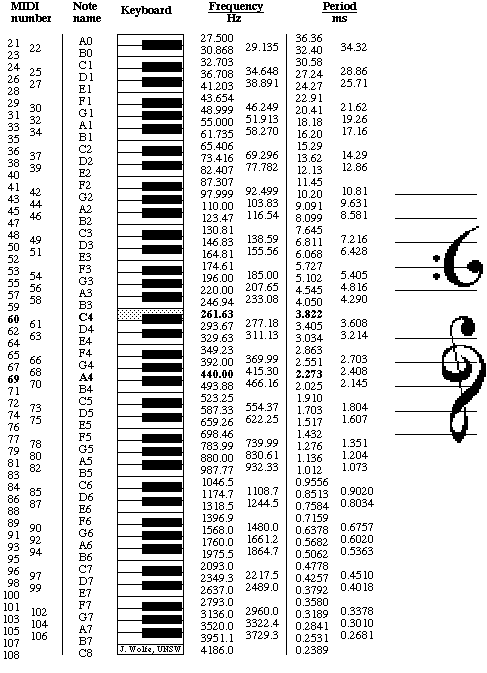
Kick: Low frequency energy (< 100Hz).
Snare: Mid-range energy (200-400Hz) with “noise” (snare wires).
Hi-Hats: High-frequency energy (> 5kHz).
For a deep dive into frequency mapping, see our MIDI Frequency Table.